
List of Ski
![[Tokyo, Ogikubo] Japanese Sashiko Embroidery workshopの画像](https://img.activityjapan.com/10/20970/10000002097001_zGJxNWPl_3.JPG?version=1717571582)
- Age 12~Age 100
- 1~2 hours
- 10:30 / 11:00 / 11:30 / 12:00 / 12:30 / 13:00 / 13:30 / 14:00 / 14:30 / 15:00 / 15:30 / 16:00 / 16:30 / 17:00
What you'll doYou have an experience of Sashiko embroidery stitching through making "Sashiko fukin"."Sashiko fukin" is known as dish towel in Japan and very popular Sashiko learning item for novices. This item is very practical. After finishing to make, you can use it as handkerchief, lunch mat, wrapping something like sandwich, flower base mat etc.The size is approx. 33cm×33cm.Although you cannot finish the stitching during the experience, you will get knowledge and skill how to complete it by yourself. Therefore you can enjoy the stitching even at home.Step 1: Choose a Sashiko pattern and a thread color.I've provided you with many sort of Sashiko cloths which is printed on a fabric and thread colors. Please enjoy picking your favorite one out.Step 2: Preparation.I introduce how to treat for a fabric and a thread before doing stitch.Step 3: Do Sashiko stitching.After showing my demonstration to you, you will start stitching on the cloth you chosen. This time makes you enjoy and relax!Step 4: Explain Sashiko basic role and tips.Before closing the session, I explain about general order of stitching, things to watch out for, tips and so on.
It was so fun learning how to do sashiko. The teacher was very friendly and professional, and took time with each student to help us
![*Due to the relocation of the store, reservations are currently suspended. [Asakusa, Tokyo] Artistic fan and fan painting experience. Make your own original artistic fan or fan!の画像](https://img.activityjapan.com/10/50476/10000005047601_SvzPizbd_3.jpg?version=1713592982)
- Age 5~Age 100
- Within 1 hour
- 10:00 / 11:00 / 13:00 / 14:00 / 15:00 / 16:00
*Due to the relocation of our store, we are currently not accepting reservations. Why not make your own original art fan or fan at the popular Japanese culture experience cafe in Asakusa? Choose from the traditional Japanese crafts of "fan" or "uchiwa", decorate it with your own ideas, and make your own unique fan or fan. You can easily enjoy decoration using stamps, markers, watercolors, etc. No special skills or drawing skills are required. You can create your own unique fan or fan by freely choosing the type and color of stamps and applying an original design. By incorporating modern stamp art into a traditional fan, a new art piece that combines tradition and modernity is born. Our staff will support you, so even beginners can enjoy creating. Your original fan will be a special item that you made yourself and will be a memorable and important item. It is also popular as a personal favorite item. *This experience is an experience where you paint a plain fan or fan yourself.
体験料3500円に見合わない。机の上に紙とスタンプ、絵の具、クレヨンなどの用意がされていましたが、説明はわかりきったことをほんの10秒程度。どんなやり方があるか例を聞くと「うちのインスタ見て下さい」と。インスタを見ると扇子の投稿は1〜2のみ。実物の見本もありましたが、子供さんのお絵描き程度のものです。スタンプは種類も少なくスタンプ台の色は出ず、筆はバサバサ、扇子の下に当てるゴム台もサイズが全く合っておらず小さくて、段ができてスタンプもうまく押せませんでした。道具は汚れていて扇子にも付着してしまい残念としか言いようがない体験でした。
![[Fukuoka/Kokura] Hata weaving, indigo dyeing, Ryukyu Bingata dyeing, and Kyo Bingata dyeing are friendly even for first-timers, and can be enjoyed by younger students and are popular as a way to create memories for groups!の画像](https://img.activityjapan.com/10/60727/10000006072701_iEnoYyeN_3.jpg?version=1756788663)
- Age 2~Age 100
- 1~2 hours
- 10:00 / 11:00 / 12:00 / 13:00 / 14:00 / 15:00
We create programs to suit everyone, from beginners to those aiming to improve their skills as a handicraft. ① Kokura Textile Weaving Experience ② Mojiko Textile Weaving Experience ③ Indigo Dyeing Experience ④ Ryukyu Bingata Dyeing Experience ⑤ Kyoto Bingata Dyeing Experience ①② are handwoven on a high-speed loom, and ③④⑤ allow you to take home dyed items such as T-shirts and handkerchiefs, making them the perfect way to create memories!
![[Satsuma Kirishima] 300 Year history! Experience the skills of the traditional craft "Satsuma Suzuki"! Let's make original dishes!の画像](https://img.activityjapan.com/10/13356/10000001335601_AvhKiQYw_3.JPG?version=1658021895)
- Age 3~Age 100
- Within 1 hour
- 08:00 / 09:00 / 10:00 / 11:00 / 13:00 / 14:00 / 15:00 / 16:00
At "Satsuma tinware Iwakiri Mikunido", you can experience tin plate making from adult to children. The time is about one hour, so you can participate between sightseeing. One to 10 people can be accommodated at one time. Why do not you make one original tin plate in the world?
薩摩錫器を知っていたわけではなく、面白そうと思って体験してみましたが、併設のショップで商品を見たり 動画を見せていただくことで 詳しく知ることができました! 体験自体は とても簡単で少し物足りなかったけど、誰にでもできる内容ではあると思います!
![[Satsuma/Kirishima] 300 years of history! Experience the skill of "Satsuma Suzuki"! Let's make an original plate (large plate diameter 14.5 cm)!の画像](https://img.activityjapan.com/10/46727/10000004672701_l7evFLtb_3.JPG?version=1675989028)
- Age 3~Age 100
- Within 1 hour
- 08:00 / 09:00 / 10:00 / 11:00 / 13:00 / 14:00 / 15:00 / 16:00
At "Satsuma Tinware Iwakiri Bikodo", both adults and children can experience making tin plates that are larger than usual (14.5 cm in diameter). The time is about 1 hour, so you can participate in the interval between sightseeing. We can accommodate 1 to 10 people at a time. Why don't you make one original tin dish in the world?
![[Ishikawa/Kaga] Full-scale lacquer painting experience: Make lacquer-painted chopsticks - Includes cafe time with lacquerwareの画像](https://img.activityjapan.com/10/55741/10000005574101_4SVvNR9D_3.jpg?version=1723347305)
- Age 6~Age 100
- 1~2 hours
- 10:30 / 13:00 / 14:30
"Studio Seikan" is a facility with a workshop, shop and cafe, where you can visit the manufacturing site of Yamanaka lacquerware, experience woodturning, shop, and enjoy cafe and sweets with lacquerware. This course includes a workshop tour (with explanation) - making a vase - lacquerware experience at the cafe (one drink included). Lacquerware craftsmen work here every day. In this experience, you can observe them up close and learn about lacquerware production. The staff will explain it in an easy-to-understand way. Next, you will make your own original lacquered chopsticks at the place where the craftsmen actually work. Think about the design of the chopsticks and paint them with real lacquer. You can experience authentic lacquer painting. The lacquer craftsmen will teach you carefully, so you can make them yourself until they are completed. You will surely be satisfied. It's fun. After that, you can enjoy drinks made with lacquerware at the cafe and taste sweets. Please relax and enjoy the lacquerware experience. Please feel free to ask the staff or craftsmen if you have any questions. Lacquer can cause a rash, but we check beforehand and use gloves to prevent it from coming into contact with the skin, so even small children can experience it. If you notice any abnormalities on your skin, please tell a member of staff immediately. Please note that we cannot take responsibility in the unlikely event of a rash occurring. Please be aware that lacquer may also adhere to clothing, and wear clothes that you don't mind getting dirty. *The information and photos posted may not be the latest information. Please be sure to check for yourself before using.
![[Hyogo, Himeji] Express important words with kanji and calligraphy. Enjoy calligraphy casually and empty-handed. A successful experience on a half-tatami mat.の画像](https://img.activityjapan.com/10/53896/10000005389601_vD2bM8wN_3.JPG?version=1717785302)
- Age 10~Age 100
- Within 1 hour
- 10:00 / 11:30 / 13:30 / 15:00
For international customers, why not express your soul through calligraphy? You will be able to write your name, motto, favorite words, and anime characters in kanji. Immerse yourself in the rich tradition of Japanese calligraphy right next to the iconic Himeji Castle. Feel the real brush strokes as you embark on a journey through centuries of cultural heritage. Join us for an unforgettable experience that will inspire your creativity and deepen your understanding of the art of calligraphy. Don't worry if you are a first-timer, any skill level is welcome. Awaken your senses to the beauty of calligraphy. Our instructors will help you. For domestic customers, this is a calligraphy experience centered on kanji. Why not express your heart through calligraphy? Write your favorite characters, mottos, and words for loved ones in kanji. Why not spend a rich, brief moment, slowly settling your mind and feeling the aroma of ink? For first-timers and experienced people alike. Awaken your senses to the beauty of calligraphy. Our instructors will support you carefully. Whether you are a first-timer or an experienced person, you can relax and enjoy making memories of your trip! The room is a Japanese-style room with tatami mats, but you can choose to practice calligraphy at a table with a Terakoya desk and chair in seiza. Let's enjoy experiences that you can't usually have, from practicing on Hanshi paper to creating works on colored paper and postcards! ~Experience flow~ ①Explanation of the experience plan and hearing. (5 minutes) While drinking tea, we will ask you about today's plan. ②The teacher will create a sample. (5 minutes) The teacher will write a sample of the desired calligraphy style and decide the activity content. ③Start practicing on Hannsi (Japanese calligraphy paper) (20 minutes) You will practice freely while adding explanations of brushes and kanji. Even if it's your first time, you can practice as many sheets as you like with free expression. ④A lecture before finishing the final work and an explanation of the points to finish the work. (10 minutes) If you would like to do a large-scale wall calligraphy performance, we will hold a first trial performance. If you wish, we will hold a lecture before finishing your work, such as making Shikishi (traditional Japanese square paper), postcards, or Sensu (traditional Japanese holding fan). After that, you can practice on special paper. Enjoy free expression. ⑤ Completion of the work and a commemorative photo. The finished work will be stamped with a finishing seal, and you will be given a commemorative photo and a digital video upon request. *We can also set a "time extension" for the leisurely time upon request. Up to 1 hour and 30 minutes.
![[Kyoto/Kamigyo Ward] "Kinsai Yuzen Experience" Our original! Kyoto-A cultural experience to enjoy in Nishijinの画像](https://img.activityjapan.com/10/14926/10000001492601_IIlO4Vwt_3.jpg?version=1581567619)
- Age 6~Age 100
- 1~2 hours
It is a plan to apply “Kinsai Yuzen” technique to the campus fabric. You can choose one from book cover, drawstring, and mattress. Time required About 1 hour to 1 hour 30 minutes. Desired design (background)On the day Please bring it. Sample designs are also available. The finished product is On the day You can take it home. Skilled craftsmen will carefully support you, so you can complete a wonderful work. All of them are practical, so they will be appreciated as gifts. Kyoto How about making wonderful memories?
![[Hyogo, Minami Awaji] Awaji tiles, a traditional industry with 400 years of history. A tile maker who continues to challenge himself to create the beauty of Japanese architecture. A coaster-making experience.の画像](https://img.activityjapan.com/10/58552/10000005855201_1Gz5AIDf_3.webp?version=1743738427)
- Age 6~Age 100
- 2~3 hours
- 09:00 / 10:00 / 11:00 / 13:00 / 14:00
Daisuke Michigami, a roofer who has inherited the family business (president of Daiei Ceramics), continues to take on the "indefatigable challenge" of unraveling the "wisdom," "skills," and "teachings" of his predecessors that are embedded in each and every "Awaji tile," a traditional industry that has a history of 400 years, and passing them on to the future. What is the reason for continuing to take on new challenges? We will get to the bottom of the secret. Daisuke Michigami, a roofer, will talk about the charm of "tiles" created by the soil of Awaji over time, the thoughts he puts into making each and every tile, the scenery created by the layers of "tiles," and his commitment to the "beauty" of Japanese architecture, all at "Gallery Doza," a space completely wrapped in soil and tiles. Awaji tiles were hit hard by the unfounded rumor that "the damage caused by the Great Hanshin-Awaji Earthquake was so great because the roofs were tiled." Even in an environment where the survival of Awaji tiles is still in doubt, Michigami has found great potential in "Ginfurubi" (tiles that are new yet somehow nostalgic, baked to a vintage, antique texture), and has been bringing out new charms of Awaji tiles that are different from anything that has come before. Now that his thoughts have taken shape, tiles are connecting people with each other, and Japan's good old traditional beauty is being reevaluated. Tile maker Michigami Daisuke's "insatiable challenge" will continue. After listening to his story, you can enjoy a space surrounded by earth and tiles that you would never believe is inside a tile factory, a view of the townscape that has flourished due to tile production since the Edo period, and Michigami's passion for "beauty" at "Gallery Doza," where you can feel Michigami's passion for "beauty." You can pretend to be a tile craftsman and try making your own "one-of-a-kind tile coaster," one of the new possibilities of tiles. You can choose from a variety of Japanese pattern designs that are prepared in advance, as well as original designs. Try making a rich work full of your sensibility. Experience schedule9:00~ (20 minutes) Message from tile maker Daisuke Michigami (President of Daiei Ceramics Co., Ltd.) - "Creating the future of tiles" - He will talk while showing slides at [Gallery Doza].9:20~11:20 Experience making your own original tile coaster that is one of a kind in the world *You can start at any time between 9:00 and 14:00.
![[Tokushima / Katsuura Town] Experience fascinated by the skills of modern master craftsmen and Japanese knives!の画像](https://img.activityjapan.com/10/36453/10000003645301_ygFvU1X1_3.jpg?version=1622881373)
- Age 0~Age 99
- 2~3 hours
"Okubo Blacksmith" made with traditional techniques is a field blacksmith that has been around for 100 years. Each carefully made kitchen knife is easy to cook, sharp and delicious, so it is popular with the general public and is also used by professional cooks. It is Mr. Kimasa, the 3rd generation, and Mr. Ryuichi, the 4th generation, who continue to make kitchen knives that cannot be parted once used. Mr. Kimasa has a wonderful skill that was selected as a master craftsman of the present generation, and there are many customers from all over the country who come for kitchen knives. In a workshop that feels like you have traveled back in time to the world of old tales, you can observe the making of kitchen knives with brilliant craftsmanship and bring back one all-purpose kitchen knife to the world. ~ Flow of the day ~ 1. Blacksmith Okubo Parents and children about techniques (Characteristics of iron knives, how to sharpen, how to handle) 2. Experience of cutting vegetables with Japanese knives and checking the sharpness and taste 3. Tour of the knife making workshop * Takeaway gift ・ Take away one desired all-purpose kitchen knife. * You can enter your name if you wish.
![[Kyoto, Ukyo Ward] Experience authentic dyeing at a Kyoto studioの画像](https://img.activityjapan.com/10/61184/10000006118401_D72lNZF7_3.JPG?version=1759907944)
- Age 7~Age 100
- 1~2 hours
- 10:00 / 14:00
This special program allows you to experience the traditional Kyoto craft of Itaba Yuzen. Under the guidance of a skilled craftsman, you can create your own unique stencil dyed piece and take it home with you. While learning about the history and culture of stencil dyeing, you can experience the joy of handcrafting and the beauty of color up close. The finished piece will remain as a memory, and you will also gain a sense of discovery and accomplishment in the production process, making this a valuable experience that can only be enjoyed here.
![[Hyogo, Minami Awaji] Try your hand at making onigawara tiles, a tradition that has continued for over 400 years! Learn from a master craftsman, the oni-shiの画像](https://img.activityjapan.com/10/58778/10000005877801_1Gz5AIDf_3.webp?version=1744699742)
- Age 13~Age 100
- 3~4 hours
- 10:00
With a history of 1400 years, tiles have protected Japanese houses, including shrines and temples. Among them, there are "Onishi" who have the skills of a master craftsman who draws a blueprint in his head while looking at the drawing with his own eyes without using blueprints or molds, and finishes it only with the sense of his fingertips and a handmade spatula. You can make a one-of-a-kind oni tile by learning from an "Onishi" how to make oni tile by hand using "name-do" soil that is more than 2 million years old. Awaji Island is one of the three major production areas of tiles in Japan, and is the number one producer of smoked tiles that shine with "silver". Tiles have a history of more than 1400 years, and tile making has been going on in Awaji Island for more than 400 years. Moreover, the soil used for Awaji tiles is still more than 2 million years old, and the very fine particles of "name-do" are used to create smoked tiles that shine with a beautiful silver color by baking (smoking) them in a kiln. In Japan, onigawara tiles have been used to decorate roofs as a talisman since ancient times. Even today, these onigawara tiles are carefully handcrafted by oni-shi (demon craftsmen) without the use of machines. Normally, you don't get to see onigawara tiles being made, but in this experience, you can watch the onigawara craftsmen's skills up close and make onigawara tiles together. Since this experience is limited to one group, you can make onigawara tiles without worrying about other people. If you have any questions or questions about how to make them, you can ask the onigawara maker at any time, and it is an experience where you can experience traditional techniques in a private atmosphere. [Procedure] 1. Draw a rough sketch of the image (you can also bring a draft with you) 2. Decide on the design of the onigawara tile 3. Together with the onigawara maker, use tile clay (nametsu) to create a rough shape 4. Let it cure (eat lunch (each person) during this time) 5. Finish the fine details using a spatula and your fingertips 6. Completed (you can also take a commemorative photo with the onigawara maker) *The work will then be carefully dried and fired and delivered in about two months. *For lunch, you can enjoy Awaji Island's specialty "Kawara-yaki" at the facility (additional charge required).
![English OK! [Tokyo/Nihonbashi] Makie experience at a 100-year-old lacquerware specialty storeの画像](https://img.activityjapan.com/10/50107/10000005010701_woIQRljm_3.jpeg?version=1756796469)
- Age 10~Age 100
- 1~2 hours
- 10:30 / 13:30
This course allows you to experience makie, one of the most representative decorative techniques in lacquerware. "Decoration" refers to the process of decorating and enhancing the surface of a product. "Makie" involves painting a picture or pattern on the surface, then sprinkling makie powder (gold, silver, or other metal powder) onto the lacquer before it hardens. This course allows you to easily create your own original lacquerware using cashew paint instead of lacquer and brass powder instead of pure gold. Note: The color of brass powder may change over time. In this course, you will choose a piece of lacquerware of your choice and create it by cutting out shapes or drawing pictures and letters freehand. Using the provided patterns makes the process easy even for those who are not skilled at drawing. You can also bring your own original design and create it yourself. "Utsuwa Nihonbashi Yumedo Main Store" is located in Nihonbashi, Tokyo, an area with many long-established traditional craft stores dating back to the Edo period. Muto, the organizer, is a long-established company with a history and tradition as a wholesaler specializing in lacquerware, founded over 100 years ago. Workshop instructors with specialized techniques will provide thorough instruction. The highlight of the experience is the moment when the color changes when the sprinkled powder is brushed away. Why not try your hand at maki-e, a traditional and unique Japanese technique?
- Age 10~Age 75
- Over 6 hours on the day
- 09:00
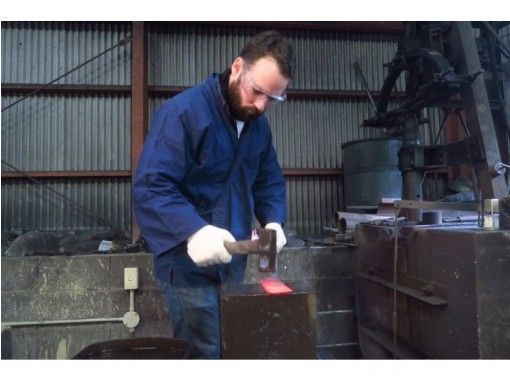
Enjoy traditional handcrafting experience at blacksmith's. As we are living in a society where people are more and more focused on digital technology, blacksmith's skills and techniques seem to be disappearing from our lives. The Tatara Steel Manufacturing & Forging Workshop located on the Shimanto riverside offers knife forging experience.
![[GEMBA Monozukuri Expo 2023] Traditional Japanese techniques! Experience the world of joinery that does not use a single nailの画像](https://img.activityjapan.com/10/51110/10000005111001_gfrlJ0xj_3.jpg?version=1696215673)
- Age 6~Age 100
- 1~2 hours
- 09:30 / 14:00
See, touch and experience. Learn all about the charm of joinery! Kamon Joinery Crafts is a joinery shop that produces furniture, fittings, and other "joinery" made by combining wood and wood without using joining tools such as nails. In this program, you will be able to experience Kumiko work under the guidance of President Kamon, who has honed his skills as a joiner for over 50 years. Please come and experience for yourself how the beautiful intricate patterns of Kumiko work are made and how difficult Kumiko work is.
Search by recommended experience







最近チェックしたプラン
Please wait a moment